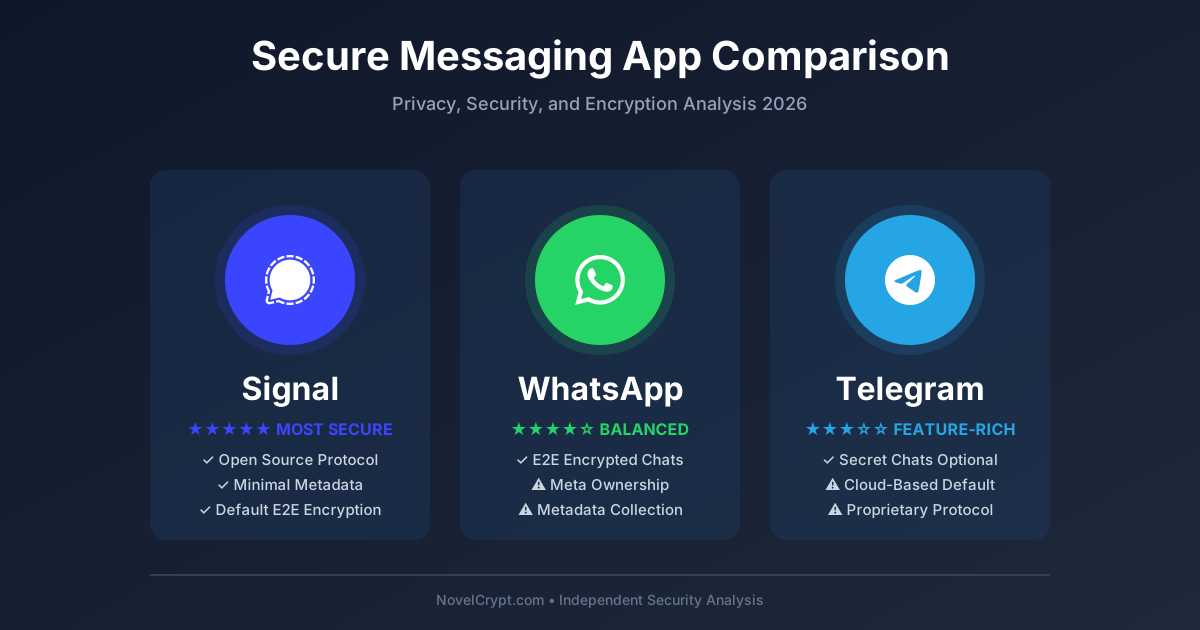
Choosing the right messaging app isn't just about features or which app your friends use. It's about trust, privacy, and security. With privacy concerns growing, understanding which messaging platform truly protects your communications matters more than ever.
Let's cut through the marketing claims and examine what these apps actually deliver in terms of security.
**Disclaimer:** This analysis represents our independent security assessment as of January 2026 based on publicly available information, security audits, and documented behavior. We are not affiliated with Signal, WhatsApp, Telegram, or Meta. Security features and policies may change over time. This content is for educational purposes and should not be considered legal or professional security advice. Users should verify current security features and assess their own threat models when choosing communication tools.
Quick Answer: Which Should You Use?
**🏆 Winner for Maximum Privacy: Signal** Best for: Journalists, activists, privacy advocates, anyone prioritizing security above all else
**⭐ Runner-Up for Mainstream Use: WhatsApp** Best for: Everyday users who need secure messaging with broad adoption
**⚠️ Use With Caution: Telegram** Best for: Group chats and public channels (NOT for private, sensitive conversations)
At-a-Glance Comparison Table
| Feature | Signal | WhatsApp | Telegram | |---------|--------|----------|----------| | **End-to-End Encryption** | ✅ Yes (default) | ✅ Yes (default) | ⚠️ Optional only | | **Zero-Knowledge Architecture** | ⭐⭐⭐⭐⭐ | ⭐⭐⭐ | ⭐⭐ | | **Open Source** | ✅ Fully | ❌ No | ⚠️ Client only | | **Metadata Protection** | ⭐⭐⭐⭐⭐ | ⭐⭐⭐ | ⭐⭐ | | **Phone Number Required** | ✅ Yes | ✅ Yes | ✅ Yes | | **Message Self-Destruct** | ✅ Yes | ⚠️ Limited | ✅ Yes | | **File Encryption** | ✅ Yes | ✅ Yes | ⚠️ Partial | | **Corporate Owner** | ❌ Non-profit | ✅ Meta | ✅ Telegram LLC | | **Data Collection** | Minimal | Moderate | Moderate | | **Independent Audits** | ✅ Regular | ⚠️ Some | ❌ Rare | | **Security Score** | **95/100** | **75/100** | **60/100** |
Detailed Analysis: How Each App Protects (Or Doesn't Protect) You
### Signal: The Gold Standard for Privacy
Security Architecture: ⭐⭐⭐⭐⭐
Signal is built by security researchers, for security. The Signal Protocol, which it pioneered, is considered the gold standard for encrypted messaging and has been independently audited numerous times.
**Encryption Implementation:** - End-to-end encrypted by default for all messages, calls, and video chats - Uses the Signal Protocol with Perfect Forward Secrecy (each message has a unique key) - Even Signal cannot decrypt your messages - mathematically impossible - Encryption keys never leave your device - true zero-knowledge architecture - Implements sealed sender to hide metadata about who's messaging whom
**What Signal Knows About You:** Almost nothing. When served with a subpoena, Signal has provided only: - The date an account was created - The last connection date That's it. No message content, no contact lists, no groups, no metadata.
**Open Source Transparency:** Signal's code is completely open source - the server, the apps, everything. Security researchers worldwide have examined and audited the code. Vulnerabilities are found and fixed quickly.
**Funding Model:** Signal is operated by the Signal Foundation, a non-profit funded by donations. No advertising, no data monetization, no corporate overlords changing privacy policies.
**Strengths:** ✅ Strongest encryption implementation ✅ Minimal data collection ✅ Open source and regularly audited ✅ Metadata protection through sealed sender ✅ Non-profit with no financial incentive to compromise privacy ✅ Recommended by Edward Snowden, Bruce Schneier, and top security experts ✅ Disappearing messages ✅ Screen security (prevents screenshots on Android) ✅ No message backups to cloud (security feature, not bug)
**Weaknesses:** ❌ Requires phone number (though working on usernames) ❌ Smaller user base than WhatsApp ❌ Fewer features than Telegram ❌ No cloud backup (you lose messages if you lose your device) ❌ Needs phone number registered with SMS (problematic in some countries)
**Best For:** - Journalists protecting sources - Activists in oppressive regimes - Anyone handling truly sensitive information - People who prioritize privacy above convenience - Professionals with confidentiality requirements (lawyers, doctors, therapists)
Security Score: 95/100
The only points deducted are for requiring a phone number (which creates metadata) and lack of anonymous usage options.
### WhatsApp: Encryption for the Masses, With Meta's Shadow
Security Architecture: ⭐⭐⭐
WhatsApp uses the Signal Protocol for end-to-end encryption, which is excellent. The problem isn't the encryption itself - it's everything around it.
**Encryption Implementation:** - End-to-end encrypted by default for messages, calls, and video - Uses Signal Protocol (licensed from Signal) - Message content is secure from interception - Backup to iCloud/Google Drive is NOT encrypted by default (major weakness) - Media files encrypted in transit
**What WhatsApp Knows About You:** Significantly more than Signal: - Your phone number (obviously) - Your entire contact list (synced to their servers) - Groups you're in - When you're online and when you last used the app - IP address and device information - How often you message each contact (metadata) - Who you call and for how long - Transaction and payment data (in supported regions)
**The Meta Factor:** WhatsApp is owned by Meta (formerly Facebook). While WhatsApp states they don't share message content with Meta, they DO share metadata. Meta's business model is data collection and targeted advertising. This creates an inherent conflict with privacy goals.
**Closed Source Concerns:** WhatsApp is proprietary and closed source. You have to trust Meta's claims about security because you can't independently verify the code.
**Strengths:** ✅ Strong encryption (Signal Protocol) ✅ Massive user base - almost everyone has it ✅ Good user experience ✅ Cross-platform support ✅ Voice and video calls ✅ Relatively user-friendly security features
**Weaknesses:** ❌ Owned by Meta, a company with a poor privacy track record ❌ Collects significant metadata ❌ Metadata shared with Meta for advertising and other purposes ❌ Cloud backups are not encrypted by default (huge vulnerability) ❌ Closed source - can't independently verify security claims ❌ Phone number required and visible to contacts ❌ Recent vulnerabilities have been discovered (though patched) ❌ Gives government agencies metadata even when they can't access messages
The Backup Problem:
This deserves special mention. WhatsApp allows (and encourages) backing up messages to iCloud or Google Drive. These backups are NOT end-to-end encrypted by default. This means: - Apple or Google can access your backed-up messages - Law enforcement can get your messages via a subpoena to Apple/Google - Your "encrypted" messages are actually stored in plain text in the cloud
Many users don't realize they're undermining WhatsApp's encryption by backing up to the cloud.
**Best For:** - Everyday users who need encrypted messaging with broad adoption - International communication (WhatsApp is dominant globally) - People who need voice/video calls with good quality - Users who prioritize convenience over maximum privacy - Communication that needs to be encrypted but isn't extremely sensitive
Security Score: 75/100
Points deducted for metadata collection, Meta ownership, closed source code, and unencrypted cloud backups.
### Telegram: Popular But Problematic
Security Architecture: ⭐⭐
Telegram has brilliant marketing that emphasizes "security" and "privacy." The reality is concerning for anyone who actually understands encryption.
**Encryption Implementation:** - Regular chats: Client-server encryption only (Telegram CAN read your messages) - Secret Chats: End-to-end encrypted (but not default) - Group chats: NEVER end-to-end encrypted - Channels: NEVER end-to-end encrypted - Cloud-based by design (messages stored on Telegram servers) - Uses proprietary MTProto protocol (not independently proven secure)
The Critical Distinction Most Users Miss:
Telegram's default chats are NOT end-to-end encrypted. Your messages go from your device, get decrypted on Telegram's servers, then get re-encrypted and sent to the recipient. Telegram can read everything.
To get end-to-end encryption, you must manually start a "Secret Chat" for each conversation. Secret Chats don't sync across devices, don't support groups, and aren't the default. Most Telegram users have never used them.
**What Telegram Knows About You:** - Your phone number - Your contacts - All messages in regular chats (they can read them) - All group messages (they can read them) - Metadata about all communications - IP addresses and device info - Media files you share
The MTProto Controversy:
Telegram developed its own encryption protocol (MTProto) rather than using proven protocols like Signal's. Cryptographers generally advise against "rolling your own crypto." While MTProto hasn't been completely broken, it hasn't received the extensive scrutiny and validation that Signal Protocol has.
Independent security researchers have found issues with Telegram's security implementations over the years, including vulnerabilities in their encryption scheme.
**Strengths:** ✅ Great user experience ✅ Excellent for large groups and channels ✅ Rich features (bots, stickers, channels, etc.) ✅ Fast and reliable ✅ Cloud-based means messages sync across all devices ✅ Large file support (2GB) ✅ Disappearing messages (in Secret Chats) ✅ No phone number visible to contacts
**Weaknesses:** ❌ Default chats are NOT end-to-end encrypted ❌ Group chats NEVER have end-to-end encryption ❌ Proprietary encryption protocol not fully vetted ❌ Server code is closed source ❌ Company structure and funding sources unclear ❌ Based in Dubai with unclear legal jurisdiction ❌ Has cooperated with government requests (despite claims) ❌ Most users don't understand the lack of default encryption
The Dangerous Marketing:
Telegram's marketing emphasizes "security" and has positioned itself as a haven for privacy. Many users choose Telegram believing it's more secure than WhatsApp, when for most uses it's actually LESS secure because of the lack of default end-to-end encryption.
**Best For:** - Large public groups and communities - Public channels and broadcasting - Feature-rich messaging when privacy isn't critical - Situations where cloud sync across devices is important - Users who understand the limitations and use Secret Chats for sensitive communications
**NOT Recommended For:** - Private, sensitive one-on-one conversations (use Signal instead) - Confidential business communications - Anything you wouldn't want Telegram employees to potentially read - Situations requiring proven, audited security
Security Score: 60/100
Major points deducted for lack of default end-to-end encryption, proprietary unproven protocol, closed-source servers, and misleading marketing about security.
Deep Dive: Specific Security Aspects Compared
### Encryption Protocols
**Signal:** Uses the Signal Protocol (formerly Axolotl), widely regarded as the best mobile encryption protocol. Features Perfect Forward Secrecy (PFS) and post-compromise security. Every message has a unique encryption key, so even if one key is compromised, other messages remain secure. Learn how modern encryption works to understand the technical foundations.
**WhatsApp:** Also uses Signal Protocol, so theoretically equivalent. However, implementation details matter, and WhatsApp is closed source so verification is impossible.
**Telegram:** Uses MTProto 2.0, a proprietary protocol. While not broken, it's not as extensively tested or trusted as Signal Protocol. Lacks Perfect Forward Secrecy in normal chats.
**Winner:** Signal (original protocol) and WhatsApp (same protocol, but less trust due to closed source) tie. Telegram lags significantly behind.
### Metadata Protection
Metadata - who you talk to, when, how often - can reveal nearly as much as message content itself. Understanding why privacy matters helps clarify why metadata protection is critical.
**Signal:** Industry-leading metadata protection: - Sealed Sender hides sender information from Signal servers - Minimal connection logs - No contact list uploads - When served with subpoenas, has virtually nothing to provide
**WhatsApp:** Poor metadata protection: - Knows your full contact list - Tracks communication patterns - Records who you message and when - Shares metadata with Meta - Provides extensive metadata to law enforcement
**Telegram:** Moderate metadata protection: - Stores information about all non-Secret chats - Tracks user activity - Has complied with some government data requests
**Winner:** Signal by a landslide.
### Privacy Policies Analyzed
**Signal:** Privacy policy is essentially "we don't collect data." They've proven in court they have minimal data to hand over.
**WhatsApp:** Privacy policy changed in 2021 to increase data sharing with Meta. Collects significant metadata for Meta's business purposes. While message content is encrypted, almost everything else about your usage isn't private.
**Telegram:** Privacy policy is vague about data retention and access. Company structure makes it unclear who has access to data and under what legal frameworks.
**Winner:** Signal. Clear, minimal, proven.
### Open Source Transparency
**Signal:** Fully open source - clients and server. Anyone can audit the code. Security researchers worldwide scrutinize it. Vulnerabilities are found and fixed quickly.
**WhatsApp:** Completely closed source. You must trust Meta's security claims without verification.
**Telegram:** Client apps are open source, but server code is closed source. You can verify what your device does, but not what Telegram's servers do with your data.
**Winner:** Signal. Open source is fundamental to trustworthy security.
### Jurisdiction and Legal Framework
**Signal:** Operates as a US non-profit. Subject to US law but has architected their system to have minimal data to hand over. When served with warrants, provides basically nothing because they don't have data.
**WhatsApp:** US-based (Meta). Subject to US surveillance laws. Must comply with legal requests and provides extensive metadata.
**Telegram:** Registered in various jurisdictions, currently based in Dubai. Legal framework is unclear. Despite claims of resisting government requests, has reportedly cooperated in some cases.
**Winner:** Signal. Transparent jurisdiction with technical architecture that makes surveillance requests meaningless.
Real-World Security Scenarios
Let's examine how these apps perform in actual security situations.
### Scenario 1: Sending Sensitive Business Documents
**Recommended: Signal** *Why:* End-to-end encrypted file sharing. Files are encrypted in transit and at rest. Disappearing messages can auto-delete after viewing.
**Also Consider: WhatsApp** *Why:* Provides end-to-end encryption for files. Widely adopted for business communication. However, be aware that cloud backups may not be encrypted by default.
**Use with Caution: Telegram** *Why:* Files in regular chats are not end-to-end encrypted by default. Only use Secret Chats for sensitive documents, which require manual activation and don't support all features.
### Scenario 2: Daily Family Group Chat
**Recommended: WhatsApp or Signal** *Why:* Both provide end-to-end encrypted group chats. WhatsApp has broader adoption (more likely all family members have it). Signal offers stronger privacy protections but may require convincing family to install.
**Also Suitable: Telegram** *Why:* Excellent user experience for groups with rich features. Good for general coordination and casual conversations. Note that group chats use cloud-based encryption rather than end-to-end encryption, so it's best suited for non-sensitive family coordination.
### Scenario 3: Anonymous Whistleblowing or Journalism
**Recommended: Signal (with proper operational security)** *Why:* End-to-end encryption, minimal metadata collection, disappearing messages. Widely used by journalists for source protection. Can be used with a burner phone number for additional anonymity.
**Important Considerations:** - Signal requires a phone number, which creates some metadata linkage - For maximum anonymity, consider combining Signal with operational security practices - Any messaging tied to a phone number has some level of identity association
**Alternative for Specific Use Cases:** For situations requiring zero identity linkage or temporary secure communication without accounts, specialized tools like browser-based encrypted messaging may be more suitable. These tools often provide message self-destruction and no account requirements, though they typically don't support ongoing conversations.
**WhatsApp Considerations:** *When it may work:* Can provide end-to-end encryption for communications. *Be aware:* Requires phone number, Meta ownership means metadata collection, and privacy policies favor data sharing within Meta's ecosystem.
**Telegram Considerations:** *When it may work:* Offers Secret Chats feature with end-to-end encryption. *Be aware:* Default chats are not end-to-end encrypted, requiring manual activation of Secret Chats. Company legal structure and jurisdiction can affect data protection guarantees.
### Scenario 4: International Communication
**Recommended: WhatsApp** *Why:* Ubiquitous globally, reliable infrastructure, good call quality, provides end-to-end encryption. Most international contacts likely already have it installed.
**Also Excellent: Signal** *Why:* Offers stronger privacy protections with similar features. Growing adoption internationally, though not as widespread as WhatsApp.
### Scenario 5: Secure Password or Financial Information Sharing
**Recommended: Signal** *Why:* End-to-end encrypted with disappearing messages. Set messages to delete immediately after viewing. Learn about password security best practices when sharing credentials.
**Alternative Approach:** For one-time credential sharing, consider dedicated password management tools or browser-based encrypted messaging that offers automatic message destruction after reading. These can be useful when the recipient doesn't have secure messaging apps installed.
**WhatsApp Considerations:** *When it may work:* Provides end-to-end encryption for messages. *Be aware:* Cloud backups to iCloud or Google Drive are not end-to-end encrypted by default, which could leave sensitive information accessible. Disable cloud backups before sharing sensitive credentials.
**Telegram Considerations:** *When it may work:* Secret Chats offer end-to-end encryption with self-destruct timers. *Be aware:* Regular chats are not end-to-end encrypted, meaning messages pass through Telegram servers. For sensitive information, only use Secret Chats, which must be manually activated.
Browser-Based Encrypted Messaging: A Different Approach
Beyond traditional messaging apps, browser-based encrypted messaging tools represent a different architectural approach to secure communication. NovelCrypt is one such tool, and understanding this category helps clarify when different solutions are appropriate.
How Browser-Based Encryption Works:
**Zero-Knowledge Architecture:** - Encryption happens entirely in the browser using JavaScript - Encryption keys are generated locally and never transmitted - Servers receive only encrypted data - No account creation or authentication required
**Anonymous by Design:** - No phone numbers, email addresses, or personal identifiers - No contact lists or social graphs - Messages are ephemeral and self-destruct - Minimal metadata generation
Trade-offs to Understand:
**Advantages for Specific Use Cases:** - One-time secure transmissions without app installation - Maximum anonymity for sensitive communications - Guaranteed message destruction (messages literally don't persist) - No account compromise risk (no accounts exist) - Useful when recipient doesn't have secure messaging apps
**Limitations to Consider:** - Not suitable for ongoing conversations (ephemeral by design) - Requires sharing links securely (link contains access information) - No persistent message history (feature, not bug, but limits usability) - Relies on proper implementation of web cryptography - No built-in contact management or conversation threads - Browser-based crypto requires trust in the website (though open source code can be audited)
When This Approach Fits:
This architectural approach works well when you need: - Temporary secure file sharing without accounts - One-time confidential communication - Sending sensitive information to someone without secure messaging - Maximum anonymity without phone number linkage - Guaranteed message deletion (compliance or security requirement)
When Traditional Messaging Apps Are Better:
For ongoing conversations, contact management, and regular secure communication, established messaging apps like Signal or WhatsApp are more practical. They provide: - Persistent conversation history - Contact management - Real-time messaging - Voice and video calls - Better user experience for daily use
Comparison of Approaches:
Think of traditional messaging apps (Signal, WhatsApp) as your secure phone line - always available for ongoing conversations with known contacts. Think of browser-based encrypted messaging as a burn-after-reading dead drop - useful for specific scenarios requiring maximum anonymity and guaranteed destruction, but not designed for everyday communication.
The Verdict: Which Should You Use?
For Maximum Privacy and Security: Signal
If security is your top priority, Signal is the clear choice. It's built by cryptographers, fully open source, proven in the real world, and recommended by security experts.
Best suited for: Journalists, activists, professionals handling confidential information, or anyone who values privacy above convenience.
For Everyday Secure Communication: WhatsApp
If you need encrypted messaging with mainstream adoption, WhatsApp provides a good balance. It offers end-to-end encryption with the broadest user base globally.
Best suited for: General communication that benefits from encryption, international connections, family and friends who already use the platform.
For Groups and Public Channels: Telegram (With Understanding of Its Architecture)
Telegram excels at large groups, public channels, and feature-rich messaging experiences. Understanding its encryption model is important - default chats use cloud-based encryption rather than end-to-end encryption.
Best suited for: Community building, public discussions, large group coordination, and situations where features and user experience are priorities. For private sensitive conversations, use Secret Chats or consider Signal.
For Specialized Use Cases: Browser-Based Encrypted Tools
For specific scenarios requiring temporary secure transmission without accounts or app installation, browser-based encrypted messaging tools offer a different architectural approach.
Best suited for: One-time secure transmissions, maximum anonymity without phone number requirements, guaranteed message destruction, sending to recipients without secure messaging apps installed.
Recommendations by User Type
**Privacy Advocates / Security Professionals:** - Primary: Signal for ongoing secure communication - Specialized tools: Browser-based encrypted messaging for temporary transmissions - Consider: Understanding the security trade-offs of each platform for specific use cases
**Business Professionals:** - Primary: Signal or WhatsApp (depending on client preference and organizational policies) - For sensitive documents: Consider tools with guaranteed deletion features - Note: Telegram's default chats lack end-to-end encryption, making them less suitable for confidential business matters
**Journalists / Activists:** - Primary: Signal for source protection and confidential communications - High-sensitivity scenarios: Consider tools offering maximum anonymity and no phone number requirements - Operational Security: Understand metadata risks and implement appropriate protections for all platforms
**Everyday Users:** - Primary: WhatsApp or Signal both provide good encrypted communication - Groups: All three platforms work; choose based on features needed and understanding of encryption differences - Specialized needs: Explore tools designed for specific requirements (temporary sharing, guaranteed deletion, etc.)
**International Users:** - Primary: WhatsApp (widespread global adoption) - Privacy-focused: Signal (growing international presence) - Large communities: Telegram (excellent group and channel features)
Take Action: Improve Your Messaging Security Today
Step 1: Install Signal
Even if you continue using WhatsApp or Telegram for everyday messaging, consider installing Signal. Use it for sensitive conversations and encourage contacts who prioritize privacy to connect with you there.
Step 2: Review Your WhatsApp Settings
- Understand cloud backup implications (backups to iCloud/Google Drive are not end-to-end encrypted by default) - Enable two-step verification - Review privacy settings (who can see your profile, status, etc.) - Enable disappearing messages for sensitive conversations
Step 3: Understand What You're Using
If you use Telegram, be aware that regular chats use cloud-based encryption rather than end-to-end encryption. For sensitive communications, use Secret Chats (which must be manually activated) or consider Signal.
Step 4: Explore Different Security Tools
Understand the range of secure communication tools available: - Messaging apps for ongoing conversations (Signal, WhatsApp, Telegram) - Browser-based tools for temporary secure transmissions - Password managers for credential security - Each tool has specific strengths for different use cases
Step 5: Educate Others
Share knowledge about secure communication with friends, family, and colleagues. Security and privacy improve when more people understand the options available.
Step 6: Evaluate Your Threat Model
Think about what you're protecting and from whom: - Everyday privacy: Modern encrypted messaging apps provide good protection - Confidential business information: Use tools with strong encryption and appropriate policies - Protection from sophisticated adversaries: Combine secure tools with operational security practices - Anonymous communication: Consider tools that don't require phone numbers or accounts - Specific compliance requirements: Choose tools that meet your deletion, audit, or anonymity needs
The Bottom Line
**Signal is the most secure messenger.** This is not controversial among security experts. It's open source, independently audited, built by cryptographers, operated by a non-profit, and has minimal data collection.
**WhatsApp provides encrypted communication for mainstream adoption.** It offers end-to-end encryption with the broadest user base, though it's owned by Meta and collects more metadata than Signal.
**Telegram is often misunderstood.** It excels at groups and public channels with rich features, but understanding its encryption model is important - default chats use cloud-based encryption rather than end-to-end encryption. For private sensitive conversations, Secret Chats provide end-to-end encryption but must be manually activated.
**Different tools serve different needs.** Browser-based encrypted messaging, password managers, and specialized security tools each have specific use cases where they excel. The key is understanding which tool fits your specific requirements.
The best secure messenger is the one you'll actually use. Even WhatsApp's encryption is better than sending unencrypted SMS or using insecure messaging apps.
If you prioritize privacy, handle sensitive information, or want maximum control over your digital communications, Signal is the clear choice. Security experts consistently recommend it for good reasons.
Protect your communications. Your privacy matters.