In 1993, the U.S. government proposed a simple idea: every encryption device should come with a built-in backdoor that let law enforcement decrypt any communication with a court order. They called it key escrow. The cryptographic community called it the end of privacy. The debate that followed shaped encryption policy for three decades, and it is not over yet.
What Is Key Escrow
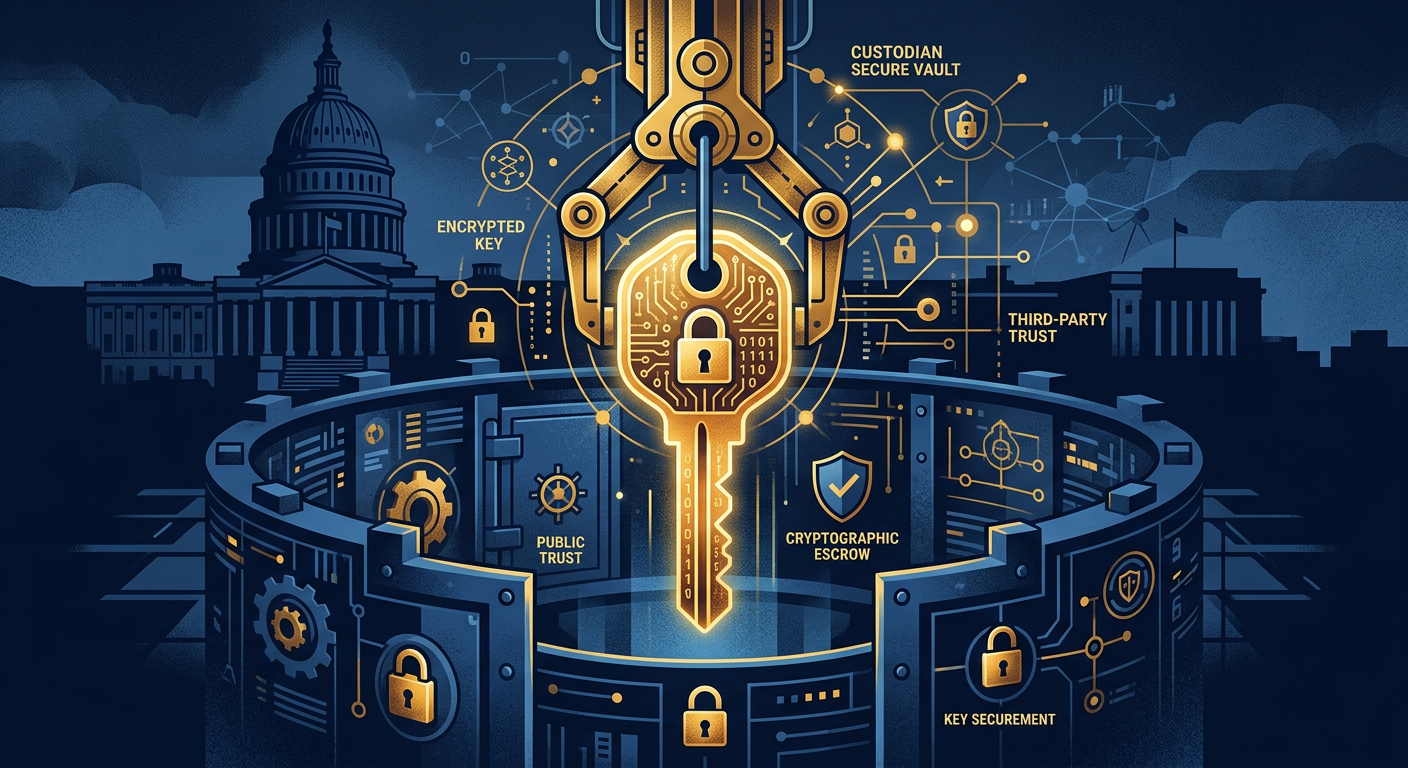
Key escrow is a system in which copies of encryption keys are stored with a trusted third party. When data is encrypted, a copy of the key is deposited with an escrow agent — typically a government agency or designated organization. If law enforcement obtains a court order, the escrow agent releases the key, allowing decryption of the target's communications.
The concept is simple to describe and devastating to implement. If you have a house key, a copy is stored at the police station. If they get a warrant, they use the copy to enter your house. The difference is that a house key opens one door. An encryption key may protect every communication, financial transaction, and personal file in a person's digital life.
### Key Escrow vs. End-to-End Encryption
| Property | Key Escrow | End-to-End Encryption | | --- | --- | --- | | Who holds the keys | Government/designated escrow agent | Only the communicating parties | | Can third party decrypt? | Yes, with court order | No, mathematically impossible | | Attack surface | Centralized key database | No central key storage | | Trust model | Trust government not to abuse access | Trust mathematics | | If escrow breached | All communications exposed | No effect — no escrow exists | | User control | None — keys are copied automatically | Full — keys never leave the user's device |
NovelCrypt uses end-to-end encryption with no key escrow. Your encryption keys are generated in your browser and never transmitted. Even if a government demanded access to NovelCrypt's servers, there would be nothing to hand over — the keys do not exist server-side. This is called a zero-knowledge architecture, and it is the direct opposite of key escrow.
The Clipper Chip: A History
The Clipper Chip was the most famous key escrow proposal in history. It was introduced by the U.S. government in 1993 as a hardware encryption chip designed for telephone communications.
### How It Worked
Each Clipper Chip contained a classified encryption algorithm called Skipjack. When a phone call was encrypted, the chip generated an 80-bit session key. Two copies of this key — split into two halves using a process called key splitting — were encrypted and sent to two separate government escrow agents: the National Institute of Standards and Technology (NIST) and the Department of the Treasury's Automated Systems Division.
When law enforcement obtained a court order, they would present it to both escrow agents, receive both key halves, reconstruct the full session key, and decrypt the phone call.
The chip also generated a Law Enforcement Access Field (LEAF) with every encrypted conversation. The LEAF contained the encrypted session key and the chip's unique serial number, allowing law enforcement to identify which escrow entries to retrieve.
### Why It Failed
The Clipper Chip failed for three reasons:
**Technical flaws.** In 1994, researcher Matt Blaze published a paper showing that the LEAF could be circumvented. A malicious user could forge a valid LEAF that pointed to escrow agents who did not have the real key, while still allowing the recipient to decrypt the conversation. The system designed to guarantee government access could be defeated without breaking the encryption.
**Economic damage.** The U.S. computer industry opposed Clipper because it would make American products less competitive globally. Customers in other countries would not buy encryption products with a U.S. government backdoor. Companies like IBM, Microsoft, and Sun Microsystems lobbied against it.
**Public opposition.** Civil liberties organizations, cryptography researchers, and privacy advocates mounted a sustained campaign against Clipper. The argument was not just about privacy — it was about the principle that the government should not have guaranteed access to private communication without demonstrating probable cause to a neutral party in real time.
By 1996, the government abandoned the Clipper Chip. The lesson seemed clear: mandatory key escrow was technically flawed, economically damaging, and politically impossible.
### The Timeline
| Year | Event | | --- | --- | | 1993 | Clinton administration announces Clipper Chip | | 1994 | Matt Blaze publishes LEAF circumvention attack | | 1995 | NSA declassifies Skipjack algorithm (no backdoor found in the algorithm itself) | | 1996 | Government abandons mandatory Clipper Chip initiative | | 1999 | U.S. export controls on encryption relaxed | | 2000 | Most encryption export restrictions lifted |
Why Key Escrow Keeps Returning
The Clipper Chip died, but the idea of key escrow did not. Every few years, a new proposal emerges that argues encryption backdoors are necessary for law enforcement. The arguments are always the same: criminals and terrorists use encryption, and law enforcement needs a way to access their communications.
### Modern Proposals
- **EARN IT Act (2020, reintroduced 2022):** Would make platforms liable for child exploitation content unless they comply with "best practices" — widely interpreted as requiring encryption backdoors or key escrow. - **UK Online Safety Act (2023):** Requires platforms to scan encrypted messages for illegal content, which is technically impossible with end-to-end encryption without breaking it. - **EU Chat Control (proposed 2022, ongoing):** Would require all messaging platforms to scan messages for child abuse material, effectively mandating client-side scanning that breaks end-to-end encryption. - **Australia's TOLA Act (2018):** Allows the government to compel companies to build technical capabilities to assist law enforcement — widely understood to include breaking encryption.
None of these proposals uses the term "key escrow." They talk about "lawful access," "client-side scanning," and "responsible encryption." But the underlying mechanism is the same: a third party must be able to access encrypted data without the user's consent.
The Technical Argument Against Key Escrow
In 1997, a group of leading cryptographers — including Hal Abelson, Ross Anderson, Steven Bellovin, Josh Benaloh, Matt Blaze, Whitfield Diffie, John Gilmore, Peter Neumann, Ronald Rivest, Jeffrey Schiller, and Bruce Schneier — published a landmark paper titled "The Risks of Key Recovery, Key Escrow, and Trusted Third-Party Encryption."
Their conclusion was unambiguous: any key escrow system is inherently less secure than end-to-end encryption without escrow. The reasons are structural:
**1. Centralized key databases are targets.** Every key escrow system requires a database of encryption keys. This database is a single point of failure. If it is compromised — by a foreign intelligence service, a malicious insider, or a hacker — every communication protected by those keys is exposed. The 2017 Equifax breach compromised 147 million records. A key escrow breach would compromise the private communications of every citizen.
**2. New attack surfaces.** Key escrow requires new infrastructure: escrow agents, key transmission protocols, court order processing systems, and key retrieval mechanisms. Each component adds attack surface. The Clipper Chip's LEAF was a new attack surface that Matt Blaze exploited.
**3. Complexity breeds vulnerability.** Encryption without escrow is simple: two parties share a key, no one else has it. Key escrow adds key splitting, key storage, key transmission, court order verification, and key reconstruction. Every step is a potential vulnerability.
**4. Scope creep.** A key escrow system designed for terrorism investigations will eventually be used for drug investigations, then tax evasion, then copyright enforcement. The technical infrastructure does not distinguish between crime severity. Once built, it is available for any purpose a government decides.
**5. Global implications.** If the U.S. builds a key escrow system, other governments will demand the same access. There is no mechanism to ensure that only "good" governments get access. A key escrow system that works for the FBI also works for authoritarian regimes.
Zero-Knowledge Architecture: The Antithesis of Key Escrow
Zero-knowledge architecture is the deliberate design choice to ensure that a service provider cannot access user data, even if compelled by law. The provider holds no keys, stores no plaintext, and has no technical capability to decrypt user data.
NovelCrypt is built on zero-knowledge principles:
1. **Keys are generated in the browser.** When you encrypt a message or file, the encryption key is created on your device using the Web Crypto API. It is never transmitted to NovelCrypt's servers. Learn more in our encryption key generator guide.
2. **Encryption happens client-side.** Your data is encrypted before it leaves your browser. The server only stores encrypted ciphertext. Even with full server access, there is nothing to read. Try this yourself with the AES text encryptor.
3. **Self-destructing messages leave no trace.** When a recipient reads a self-destructing message, the encrypted payload is deleted from the server. There is no persistent storage to subpoena. Read about how self-destructing messages work and whether Privnote-style services are safe.
4. **No server-side key storage.** NovelCrypt does not store, cache, or have access to any encryption key. The file encryptor operates entirely in your browser. If law enforcement served a warrant on NovelCrypt, the response would be: here is the encrypted data, and we do not have the keys.
This is not a policy choice that could change with a new CEO or a new law. It is a mathematical fact. The keys do not exist on the server. You cannot hand over what you do not have.
Key Escrow in Enterprise Systems
There is one context where key escrow is legitimate and widely used: enterprise key management. Organizations need to ensure that encrypted data remains accessible if employees leave, keys are lost, or devices are destroyed. Enterprise key escrow systems store copies of encryption keys in a corporate key management system (KMS).
The difference between enterprise key escrow and government key escrow is consent. In an enterprise system, the organization owns the data and the keys. It is choosing to escrow its own keys for its own business continuity. In a government system, the government mandates escrow of keys that belong to individuals, without their consent.
Enterprise key escrow is addressed by standards like KMIP (Key Management Interoperability Protocol) and is implemented in products from Amazon, Google, Microsoft, and HashiCorp. These systems manage keys for device encryption, database encryption, and file encryption.
The Ongoing Debate
The debate between law enforcement and privacy advocates has not been resolved. Law enforcement argues that encryption creates "going dark" — a situation where they have legal authority to access communications but no technical ability. Privacy advocates argue that any backdoor designed for law enforcement is a backdoor available to everyone, including criminals and hostile governments.
The cryptographic community has reached consensus: secure key escrow is not possible. The 1997 paper's conclusions have been reaffirmed by subsequent research in 2015, 2018, and 2020. The technical arguments have not changed. What changes is the political pressure to ignore them.
For individuals and organizations that need privacy, the answer is clear: use tools with zero-knowledge architecture. Use end-to-end encrypted communication. Use PGP encryption for sensitive email. Use self-destructing messages for one-time sensitive communication. Ensure your encryption keys are generated and stored on your device, not on a server that could be compelled to hand them over.
The Bottom Line
Key escrow is the idea that a third party should hold copies of encryption keys so that communications can be decrypted with legal authorization. It failed technically with the Clipper Chip in the 1990s and has been rejected by the cryptographic community in every analysis since. The fundamental problem is that any system designed to provide third-party access to encrypted data is inherently less secure than one that does not. Zero-knowledge architecture — where the service provider has no keys and no ability to decrypt — is the strongest protection against both government overreach and data breaches. NovelCrypt is built on this principle: your keys are yours, your data is encrypted before it leaves your device, and no one — not NovelCrypt, not a government, not an attacker — can decrypt your data without your key.