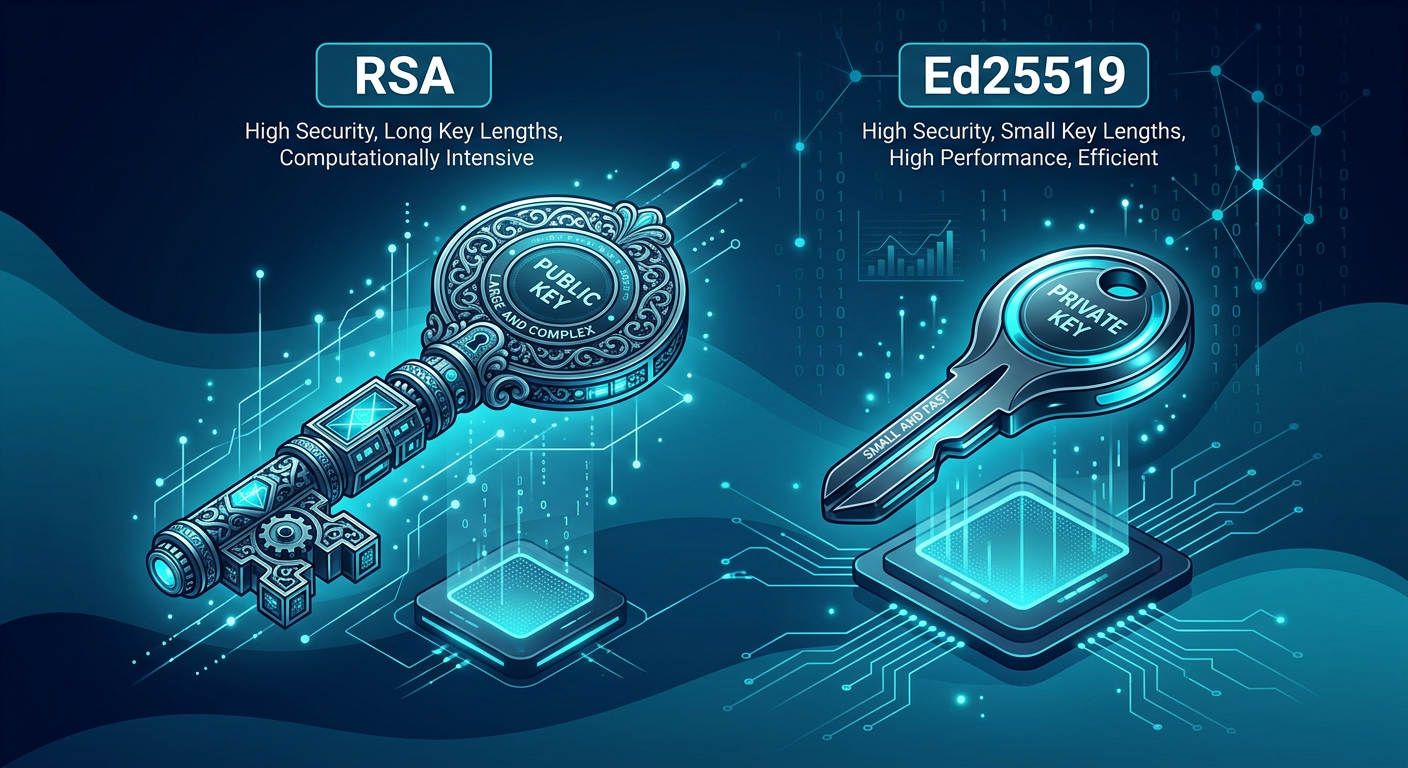
RSA has been the backbone of digital signatures since 1977. It powers HTTPS certificates, code signing, email encryption, and SSH authentication. But in 2026, RSA is showing its age. Ed25519 — a newer signature algorithm based on elliptic curve cryptography — is faster, produces smaller keys, and provides equivalent or better security. The question is no longer whether Ed25519 is better than RSA for signing. The question is whether you have a reason not to switch.
What Is RSA Signing
RSA signing uses the RSA public-key cryptosystem to create digital signatures. The signer hashes the message and applies the RSA private key operation to the hash, producing a signature. The verifier applies the RSA public key operation to the signature and compares the result to the independently computed hash.
RSA signatures are based on the difficulty of factoring large integers. The security of RSA-2048 is approximately 112 bits — meaning the best known attack requires approximately 2^112 operations. RSA-3072 provides 128 bits, and RSA-4096 provides approximately 150 bits.
RSA can be used for both encryption and signing. This dual capability is one reason RSA has remained popular — you only need one key pair for both operations. However, using the same key for encryption and signing is not recommended, and modern systems typically separate these functions.
You can experiment with RSA operations using NovelCrypt's RSA encrypt/decrypt tool and read our RSA encryption explainer.
What Is Ed25519 Signing
Ed25519 is a digital signature algorithm based on the Ed25519 elliptic curve, designed by Daniel J. Bernstein, Niels Duif, Tanja Lange, Peter Schwabe, and Bo-Yin Yang. It was published in 2011 and standardized in RFC 8032.
Ed25519 uses the Edwards-curve Digital Signature Algorithm (EdDSA). Unlike RSA, Ed25519 is purely a signature algorithm — it cannot encrypt data. For encryption, you would use X25519 (the Diffie-Hellman variant of the same curve).
Ed25519 provides 128 bits of security — equivalent to RSA-3072 and AES-128. This is considered secure for the foreseeable future by NIST, which projects 128-bit security to remain adequate beyond 2030.
For a deeper understanding of digital signatures, read our digital vs electronic signatures guide.
Key Size Comparison
The most visible difference between RSA and Ed25519 is key size:
| Algorithm | Public Key Size | Private Key Size | Signature Size | Security Level | | --- | --- | --- | --- | --- | | RSA-2048 | 256 bytes | 1,190 bytes | 256 bytes | 112 bits | | RSA-3072 | 384 bytes | 1,742 bytes | 384 bytes | 128 bits | | RSA-4096 | 512 bytes | 2,350 bytes | 512 bytes | ~150 bits | | Ed25519 | 32 bytes | 32 bytes | 64 bytes | 128 bits |
Ed25519's public key is 32 bytes. RSA-3072's public key is 384 bytes — 12x larger. Ed25519's signature is 64 bytes. RSA-3072's signature is 384 bytes — 6x larger.
This size difference matters in practice. SSH public keys in `authorized_keys` files, certificates in TLS handshakes, and signatures in blockchain transactions all benefit from smaller keys. A TLS certificate chain with Ed25519 is hundreds of bytes smaller than with RSA-3072, reducing handshake size and latency.
Performance Comparison
Ed25519 was designed for speed. The original paper reported signing speeds of 875 cycles per signature on an Intel Core 2 Duo. RSA-2048 signing on the same hardware requires approximately 2,500,000 cycles.
| Operation | RSA-2048 | RSA-3072 | Ed25519 | Ratio (RSA-3072 vs Ed25519) | | --- | --- | --- | --- | --- | | Key generation | ~500ms | ~2,000ms | ~5ms | 400x slower | | Signing | ~1ms | ~3ms | ~0.1ms | 30x slower | | Verification | ~0.1ms | ~0.2ms | ~0.3ms | 0.7x (RSA is faster) | | Signature size | 256 bytes | 384 bytes | 64 bytes | 6x larger |
Note that RSA verification is actually faster than Ed25519 verification. This matters for systems that verify many signatures (like TLS certificate chain validation or blockchain verification). However, for most applications, signing speed matters more than verification speed because signing happens at the client while verification happens at the server.
### Browser-Based Performance
In the browser, performance depends on WebCrypto API support:
- **RSASSA-PKCS1-v1_5:** Fully supported, hardware-accelerated on most platforms. - **RSA-PSS:** Supported, recommended over PKCS1-v1.5 for new applications. - **ECDSA with P-256:** Supported, but P-256 is not Ed25519. - **Ed25519:** Not supported by the Web Crypto API in most browsers as of 2026.
This is a significant limitation. If you need browser-based signing, RSA-PSS or ECDSA P-256 are your practical options. Ed25519 is excellent for server-side and command-line tools (SSH, GPG, code signing) but not yet available in the browser's native crypto API.
For browser-based operations, NovelCrypt uses RSA for the digital signer tool because WebCrypto supports it natively. For SSH passwordless login, Ed25519 is the recommended key type.
Security Comparison
| Property | RSA | Ed25519 | | --- | --- | --- | | Mathematical basis | Integer factorization | Elliptic curve discrete logarithm | | Security level (recommended) | RSA-3072 = 128 bits | 128 bits | | Quantum resistance | No (Shor's algorithm breaks RSA) | No (Shor's algorithm breaks Ed25519) | | Side-channel resistance | Depends on implementation (blinding needed) | Built-in (deterministic, no branching) | | Key generation randomness | Requires high-quality random numbers | Deterministic from seed (less sensitive) | | Nonce handling | N/A (RSA has no nonce) | Deterministic (no nonce misuse risk) |
### Side-Channel Resistance
Ed25519 is deterministic — the same message and private key always produce the same signature. This means Ed25519 does not require a random nonce during signing. This is a security advantage because nonce misuse is a common source of signature forgery.
ECDSA (the older elliptic curve signature algorithm) requires a random nonce, and if the nonce is reused or biased, the private key can be recovered. This has led to real-world breaks, including the PlayStation 3 signing key compromise in 2010. Ed25519 eliminates this entire class of vulnerability.
RSA signatures can also be vulnerable to side-channel attacks, particularly timing attacks on the modular exponentiation. RSA implementations must use blinding (multiplying by random values) to prevent timing leaks. Ed25519's design avoids branching and table lookups, making constant-time implementations straightforward.
When to Use RSA
RSA remains the right choice in several situations:
1. **You need both encryption and signing with one key pair.** Ed25519 cannot encrypt. If your system requires public-key encryption (not just signing), RSA is simpler than implementing ECIES with X25519.
2. **You are working in the browser.** The Web Crypto API does not support Ed25519. RSA-PSS or ECDSA P-256 are your native options.
3. **You are issuing TLS certificates.** Most certificate authorities issue RSA certificates by default. While ECDSA certificates are available, RSA remains the most compatible option.
4. **You have legacy systems that only support RSA.** Older SSH servers, PGP implementations, and enterprise systems may not support Ed25519.
5. **You need the widest possible compatibility.** RSA works everywhere. Ed25519 is well-supported in modern systems but not universal.
When to Use Ed25519
Ed25519 is the better choice when:
1. **You are generating SSH keys.** OpenSSH has recommended Ed25519 since 2014. Ed25519 keys are smaller, faster, and more secure than RSA keys. Read our SSH passwordless login guide for setup instructions.
2. **You are signing software packages or releases.** Ed25519's speed and small signature size make it ideal for package signing.
3. **You are building a new system with no legacy constraints.** If you do not need browser-based signing and have no compatibility requirements, Ed25519 is the modern default.
4. **You need deterministic signatures.** Ed25519 always produces the same signature for the same message and key. This is useful for testing and for protocols that require reproducible signatures.
5. **You are concerned about side-channel attacks.** Ed25519's constant-time implementation is easier to achieve than RSA's.
Migrating from RSA to Ed25519
If you are migrating an existing system from RSA to Ed25519, here is a practical approach:
### SSH Migration
1. Generate an Ed25519 key: ```bash ssh-keygen -t ed25519 -C "your-email@example.com" ```
2. Add the new public key to your servers: ```bash ssh-copy-id -i ~/.ssh/id_ed25519.pub user@server ```
3. Test that Ed25519 login works: ```bash ssh -i ~/.ssh/id_ed25519 user@server ```
4. Once confirmed working, remove old RSA keys from `~/.ssh/authorized_keys` on the server.
5. Optionally, disable RSA key authentication on the server by adding to `/etc/ssh/sshd_config`: ``` PubkeyAcceptedKeyTypes ssh-ed25519 ```
### Application Migration
1. Add Ed25519 support alongside RSA (do not remove RSA yet). 2. Generate Ed25519 keys for new users/operations. 3. Allow existing RSA users to migrate at their own pace. 4. After a migration period, deprecate RSA for new signatures. 5. Eventually, remove RSA support entirely.
Use the encryption key generator guide to understand key generation best practices, and try the RSA tool to see RSA operations in action.
Ed25519 vs RSA: Summary Decision Table
| Factor | Choose RSA When | Choose Ed25519 When | | --- | --- | --- | | Browser signing | WebCrypto only supports RSA/ECDSA | N/A — use server-side | | SSH keys | Legacy server compatibility | New setups (recommended) | | TLS certificates | Maximum CA compatibility | Modern CAs support it | | Package signing | Legacy toolchain | Speed and small signatures | | Encryption needed | RSA can encrypt | Ed25519 is sign-only | | Performance critical | Verification-heavy workloads | Signing-heavy workloads | | Key size matters | N/A | Ed25519 is 12x smaller | | Side-channel concerns | Use RSA-PSS with blinding | Ed25519 is constant-time | | Deterministic signatures | RSA-PSS is randomized | Ed25519 is always deterministic |
The Bottom Line
For digital signatures, Ed25519 is superior to RSA in almost every dimension: it is faster, produces smaller keys and signatures, is resistant to side-channel attacks by design, and does not require random nonces. The main exceptions are browser-based signing (where WebCrypto does not support Ed25519) and systems that need both encryption and signing from a single key pair. For SSH, code signing, and new signature systems without legacy constraints, Ed25519 is the clear recommendation. For digital signatures in the browser, RSA-PSS remains the practical choice. The migration from RSA to Ed25519 is straightforward for SSH and can be done gradually for applications that support both algorithms during a transition period.